
 Program
 YouTube
 Instagram
 Facebook

2025/26, ongoing
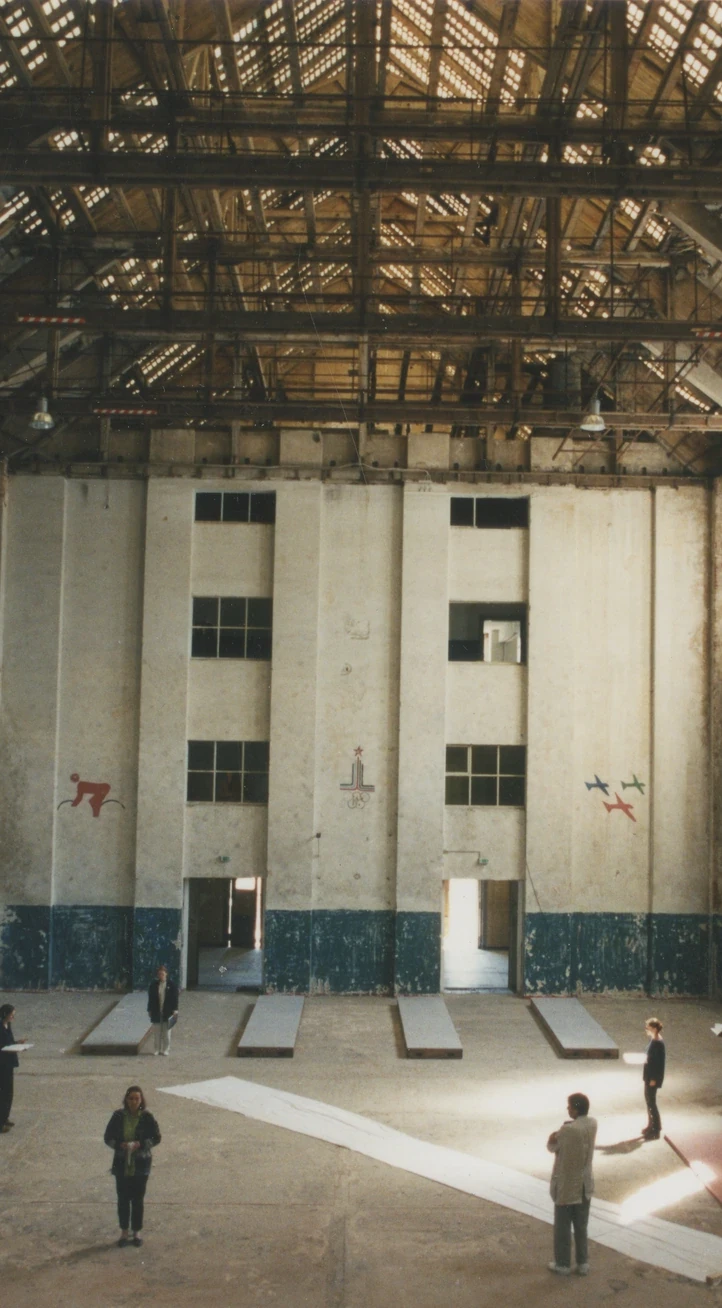
The two murals bear witness to the eventful history of the Festspielhaus Hellerau. Built in 1911 by Heinrich Tessenow in the Reform architecture style as an educational institution for music and rhythm, the Festspielhaus was used by the Nazis from 1939 to 1945 as an SS police and weapons training school. After 1945, it initially served as a military hospital for the Soviet Army, and subsequently as barracks until the Soviet troops withdrew in 1992.
The paintings in the stairwells, along with other works, were painted in 1979 by a Belarusian military artist. They depict scenes from the Soviet Union’s defensive war against Germany and the subsequent liberation of Germany from National Socialism in 1945. The murals are the last remaining traces of the building’s time as barracks, preserved as a monument. They permanently mark the Festspielhaus with a specific political history and a heroic gesture that portrays the Soviet Army as a liberator.
How are these murals perceived from today’s perspective, in light of Russia’s ongoing war of aggression against Ukraine? Is the content of the paintings even questioned, or are they simply regarded as a familiar, decorative and unquestioned historical record? How does power arise that endows images with a permanent symbolic significance and even transforms them into monuments? What tension arises between the Festival Theatre’s original purpose and the propagandistic Soviet murals?
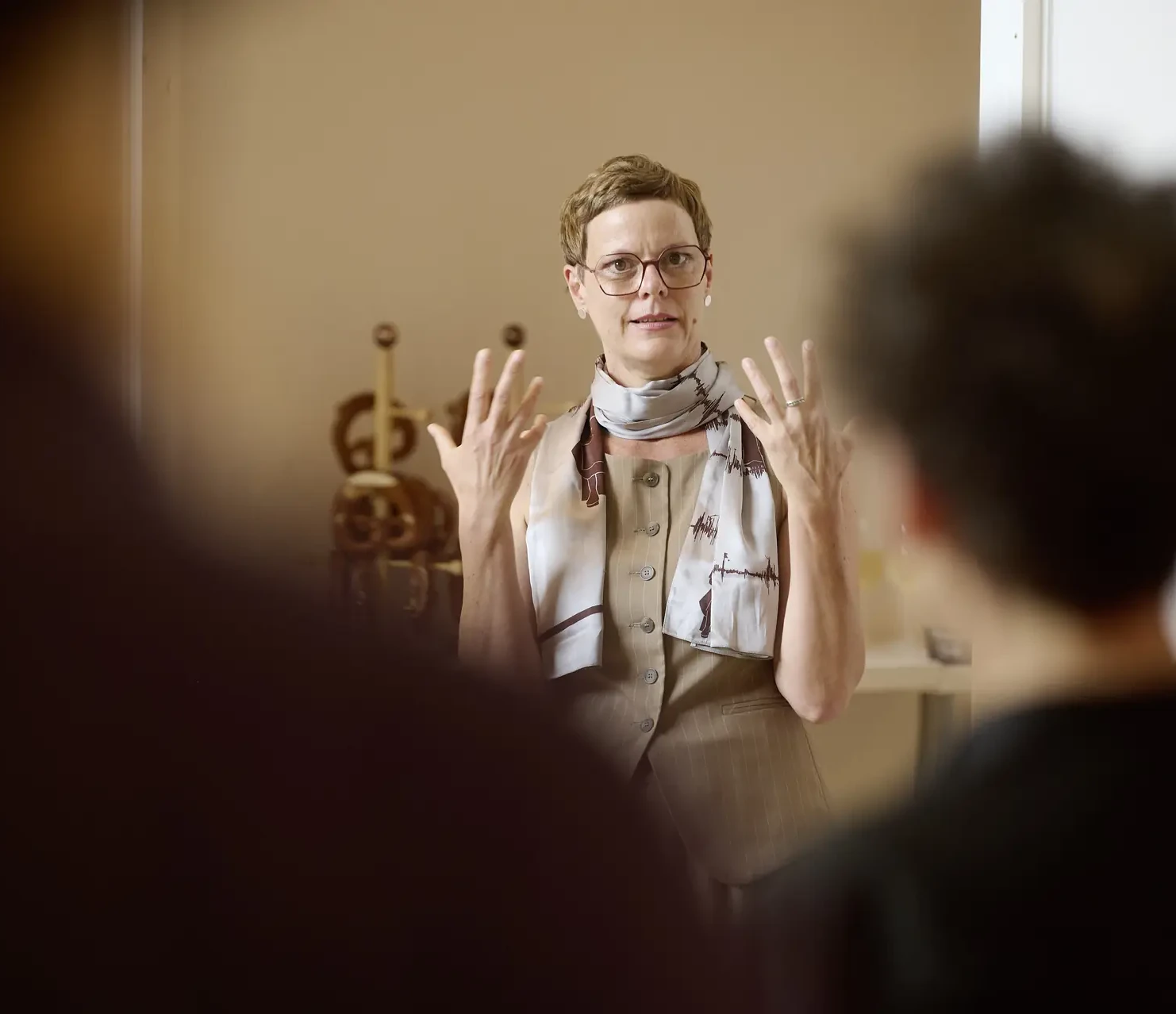
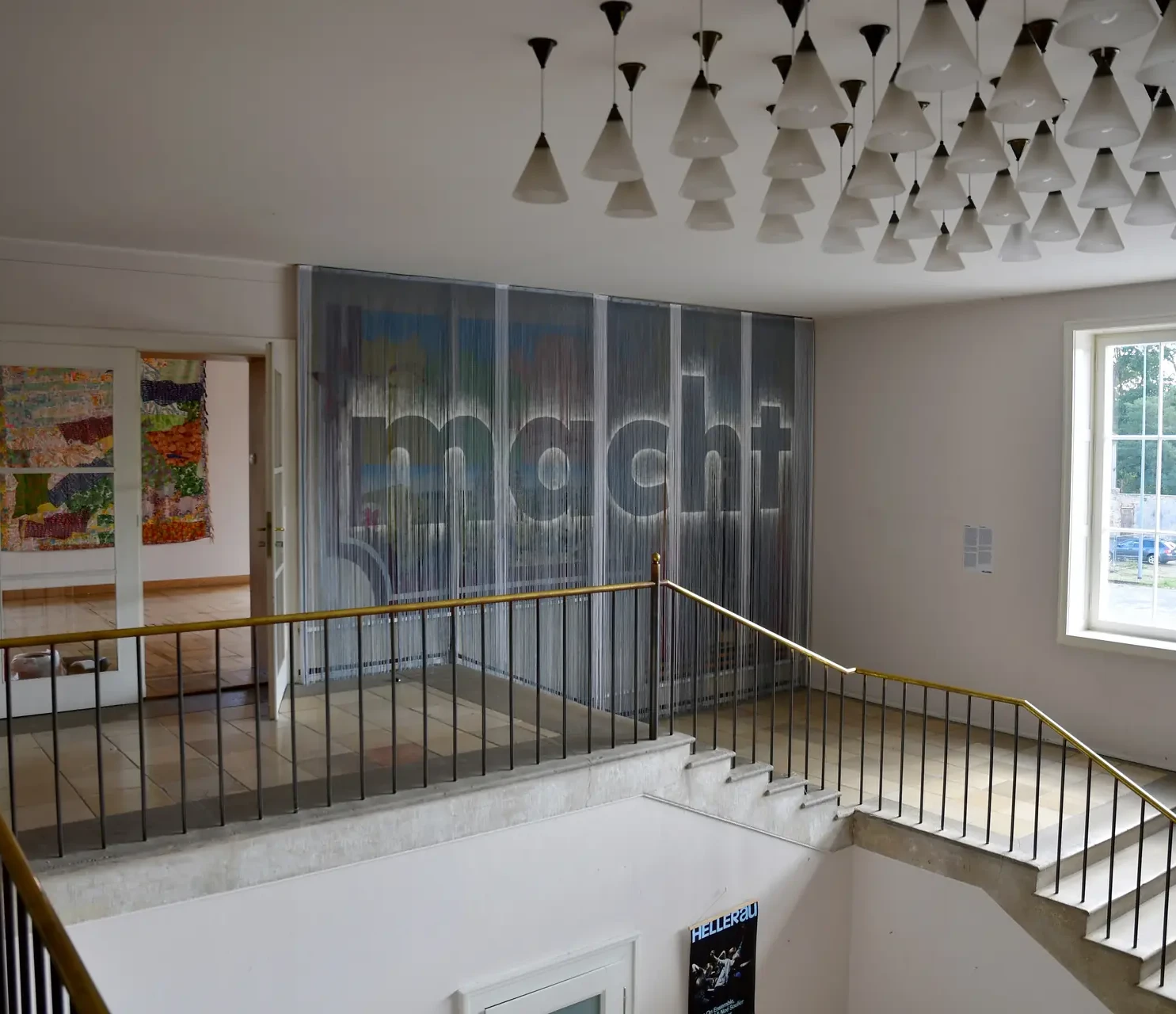
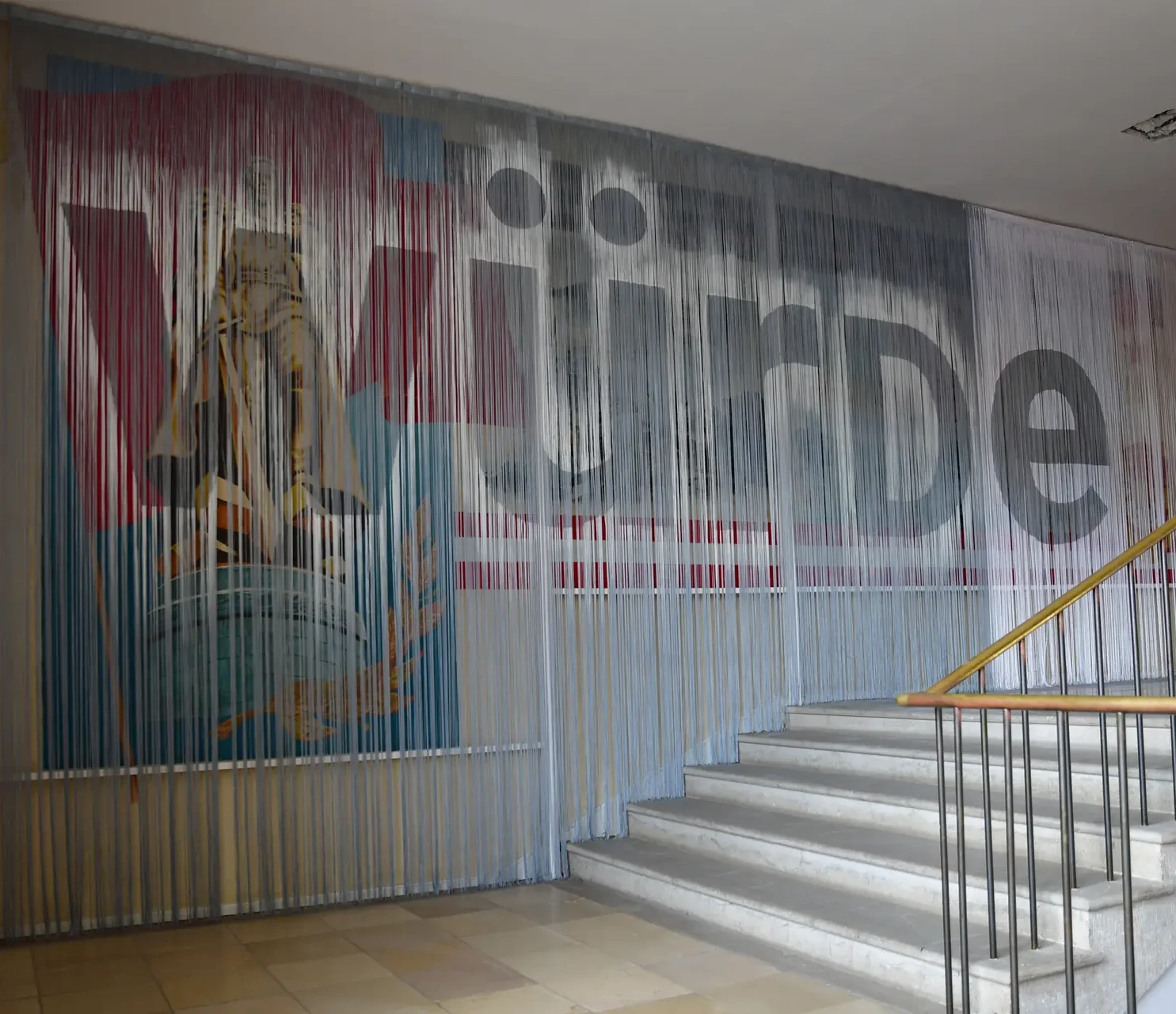
These questions prompted the visual artist Svea Duwe to re-engage with the murals by overlaying them with thread curtains, in combination with the concepts of ‘power’ and ‘dignity’, whilst still allowing the paintings to remain visible.
‘macht’ is to be understood here as a call to action. ‘Power corresponds to the human capacity not only to act or to do something, but to join forces with others and to act in concert with them.’ This is how Hannah Arendt defines it in her essay ‘Power and Violence / On Violence’ (1970). Arendt draws a strict distinction between power and violence. ‘No political leadership can replace power with violence with impunity; and it can only gain power from a public sphere that has not been distorted.’ Whilst violence relies on instruments and commanders and begins where power wanes, power is based on voluntary agreement and communication within a community.
‘würDe’ is a combination of the subjunctive form of ‘to become’ (‘würde’) and the noun ‘dignity’. Under what conditions would we do justice to the first article of the Basic Law: ‘Human dignity shall be inviolable’?
 © Stephan Floss
 © Peter R. Fiebig
 © Peter R. Fiebig
HELLERAU – European Centre for the Arts condemns in the strongest possible terms the war waged by Russian troops in Ukraine and the associated flagrant breach of international law. We are shocked by the scale of these human rights violations, by the violence being inflicted on the Ukrainian people and by the extraordinary threat to peace in Europe. We stand in solidarity with all peace-loving people and are committed to the protection of democratic, open societies.